


War in Europe - Is it possible to say anything about interest rate developments?
03 March 2022On the night of Thursday, February 24, Russia invaded Ukraine. When we thought our lives would be normalized after the Corona Pandemic, a new catastrophe began. In Europe, we have no experience of a war between two independent states since World War II. The world economy was then completely differently screwed together, so it will be difficult to extract experiences from World War II about how the results will be this time.
The background to the conflict can be simply listed as follows:
The most important historical event in relations between Russia and Ukraine took place in 1654, when Bohdan Khmelnytsky, a Cossack leader who led the uprising against Polish rule, swore allegiance to the Tsar in exchange for Russian aid to Poland.
From then until 1991, with the exception of independence between 1917 and 1920 during the period of revolution in Russia, Ukraine has been politically controlled by Russia.
In western Ukraine, most are part of the Polish-Lithuanian Church, speak Ukrainian and have a strong Ukrainian self-esteem, while in eastern Ukraine the majority are Orthodox and speak Russian.
At the reunification of Germany, it was said orally to Russia that NATO should not come an inch further east. But after that, NATO has incorporated former Eastern bloc countries and de facto moved the "NATO border" further east. If Ukraine also became a member of NATO, it could mean Western-controlled nuclear weapons close to Russia.
The world community and especially what we call the Western world has reacted quickly and strongly to Russia. Especially when it comes to arms deliveries to Ukraine and very strong economic sanctions. Russia is banned for all practical purposes in all arenas where the West is involved, economically, culturally and sportingly.
Germany has changed its security policy 180 degrees, they will immediately increase the defense budget by 100 billion euros, in addition they will increase defense spending to well over 2% of GDP (NATO requirements).
Finland is now considering membership in NATO, and the same discussion has started in Sweden. Norway has set aside a 50-year-old law not to supply weapons to warring parties. In sum, Europe in particular has rallied to a united front against Russia, economically and militarily.
How this will affect the economies and interest rate developments will be difficult to predict, but some factors seem to be clear:
Russia will most likely be on the brink of economic ruin if this is prolonged.
Europe will start armaments we have not seen since the 50s and 60s. Europe and NATO countries will most likely have to redefine trade in the light of a security policy picture, and this could lead to more control over ownership and where the production of defined socially critical factors takes place within their own countries. Upgrading and possible home flagging of various types of industry will in the medium term (1-5 years) lead to growth, more people in work, increased public spending, etc.
One of the damages inflicted on society by the Corona pandemic was a clear increase in inflation. A strong investment boom in secure energy supply and military rearmament will lead to further demand for raw materials and labor, which will further increase inflationary pressures. Classical economic theory should suggest higher interest rates than we see in today's market. The problem with the changes we see the contours of now is that it will mainly be public spending. Increased direct taxes will be difficult since households are already experiencing increased costs for food and energy. There will therefore probably be pressure on central banks to help keep long-term interest rates moderate. It also means money pressure if long-term interest rates should start to rise. Mortgages in the western world are already at historic highs,
For Norway, as a major supplier of the energy products oil, gas and electricity, we will be able to benefit greatly from this situation that has arisen. Further increases in electricity prices will probably be partially compensated for, so as not to hit households and businesses too hard. The Norwegian economy will probably have a formidable upswing and the challenges will be how we handle this. Norges Bank has announced an interest rate increase on 24 March, and that they will continue to raise interest rates. In his last annual speech, Governor Olsen announced that if wages and prices continue to rise, the central bank will have to respond by raising interest rates more than what is currently in the interest rate path. Given the sharp rise in raw materials, energy and oil prices we now see the contour of that may persist for a while, it may be sensible to take into account that interest rates may rise somewhat more than what is in the current interest rate path from Norges Bank. We will receive new signals about how the central bank analyzes the situation following the interest rate meeting on 24 March.
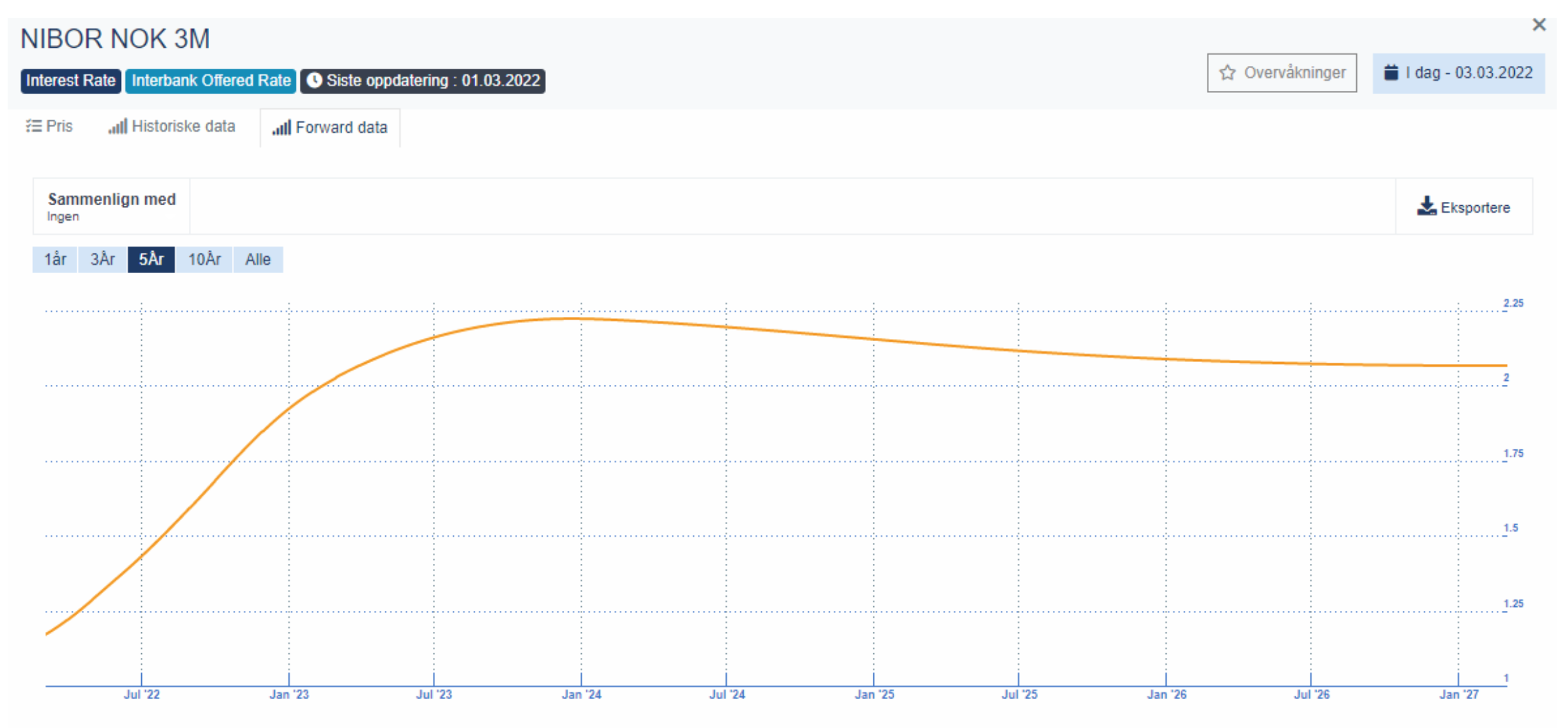
See graph below, expected 3 months interest for the next 5 years:
Disclaimer: If there is a major conflict with NATO, the picture will be completely different, this report is written on the assumption that the war will be isolated to Russia / Ukraine.